©
©
 |
 |
|||
| A GUIDE TO LIVE ROLE-PLAYING
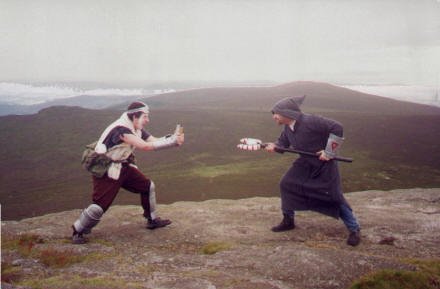
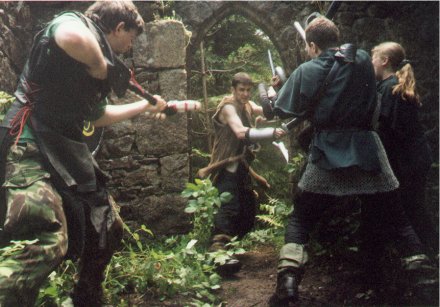
Traditional Role-playing Imagine that you were so taken by a play, film or book that you wanted to go on adventures like the characters in the tale. Role-playing allows you to do something like that. You take on the role of a character for the duration of play. You try and get inside his, her, or its mind and behave like that person would: you don't make decisions as yourself, but as your character. To allow you to play your character (known as a player character, or PC - you are the player), you use rules; therefore, the PC can have powers and abilities that you don't. Thus, you could play a great warrior from the Beowulf tales. To do so, you would come up with a background for the PC, which would explain where he is coming from, why he does what he does, as well as what he looks like. The rules would then allow you to make him good at, for example, running, and fighting. Rules will, usually, revolve around making dice throws. These will be matched against tables to see whether you have achieved what you want to do. The complexity of these rules varies from game to game. However, good role-playing (playing your PC as realistically as possible) supersedes all rules. This is only half the story: the other half is the referee. Just as in any game, the ref, upholds the rules and makes sure that everyone is sticking to them, but he or she also creates the world and all the people in it (these people are known as non-player-characters or NPCs). In the above example the ref would provide the setting for your hero's quest, and the fearsome challenges that he must overcome. In doing this the ref, normally, has help from a rules system (that gives them details on monsters and settings). Between the players and the ref an adventure is created. It is in the fine balance between keeping the world credible and allowing the players freedom to do what they want that a believable and enthralling time is had by everyone. People play the game (called timing-in) for as long as they want; although, between four to eight hours is the norm. Live Action Role-playing Live action role-playing (or LARP) is basically the same as described above: you take on the role of a character, have rules to aid playing and refs to create the world and challenges; however, you do all of this in real time and whatever your character does you will do yourself. In these games your PC can still do things that you can't; however, there are limitations on this - you look very foolish as you do a 'great-leap' and then only vault what an average human could. This is one of the main drawbacks of LARP: even with a healthy suspension of disbelief you are still limited by physical constraints. This runs through all levels of the game: as a tall player you will not be credible as a dwarf, and the refs cannot really produce streams of red-hot magma. So why bother playing? Because, it's more intense and physical than the tabletop game. You are really there, you really walk 10 miles; you really get hit and smite foes; you really watch your enemies, in the boardroom, look shocked as you outmanoeuvre them; you really sit around a camp fire and you really feel fear as the NPCs emerge from a dark forest at four in the morning. Live role-playing combines the best of fancy-dress, camping, acting and sport.
The Aspects rules are designed to meet our aims, and we have spent considerable thought and time in their formation. They are designed primarily to be fun, but also to reflect reality and allow for ancient, modern and futuristic genres to be played. So, they have to cope with mages throwing fireballs, psychics coercing people in a pub and cyberpunks unleashing torrents of shells. These demands have been balanced with ensuring that the system is simple, and fast to use. Many of the rules are concerned with combat. This does not mean that the game revolves around violence; in our regular time-ins we highlight the serious consequences of unnecessary aggression. We do not run cowboys and indians, for that people can go back to the playground. But, when combat does happen our rules allow it to be fast and for your adrenalin to kick in. We do not have a hit location system, you have an overall pool, ( which armour adds to) that goes down no matter where you are hit. As people shoot or hit you they call out damage so you know how much to deduct. All blows are pulled, that is, they are hard enough so that you know you have been hit, but no harder. Players who abuse this and who deliberately hit the out of bounds areas (head, breasts and groin) are thrown out of the game. The rules make it hard to accidentally kill another PC, but if you want to you can. They tend to land on the enjoyable rather than the realistic side. This is deliberate as it allows players to battle for the whole week-end, and, ultimately, life is unpleasant enough - role-playing should be fun. As of January 2014, the rules are in the middle of an extensive re-write to incorporate some exciting new features. As a result, the full rules document is not currently available.
|
||||
 |
 |